A "review" of Paul Tremblay - A Head Full of Ghosts
This is the story of a girl who cried a river and bored the whole world.
I have tried and failed to finish "A Head Full of Ghosts" off and on for about 3 years now. I started it around 2019 and I've finally put it down for good because I've realized I'm mortal and I have better things to do with my time than read a garbage novel that doesn't go anywhere.
I don't think I've ever reviewed a book I've never finished before, so this is a new experience for me. That said, I put this book down at page 142 of 284, coincidentally exactly halfway. Perhaps it gets good after that. Don't bother telling me, I do not fucking care and you will not change my mind.
"A Head Full of Ghosts" tries to be a horror novel. It is allegedly the story of a family with no surname. If they had one, I don't remember it and it doesn't matter. I'm going to call them the Flumps. The Flump family consists of Smokey Mom, Bible Dad, Violet from The Incredibles Only Edgy, and Merry. Merry is the youngest, blandest, and least interesting member of the family, so of course she's the only character to have a voice in the entire miserable book.
Merry is in the single digits (8? 4? Who cares?) and spends most of her time preoccupied with how the toys are arranged in her bedroom. Being so young, she is wholly disinterested in the machinations of her family and so her view is the worst possible way to tell a story about a family fractured by, I'm guessing, mental illness, marital friction, and financial struggles. Why bother exploring the potent powder keg of a fragile family dynamic wrought with money troubles when you can spend pages laboring over what kinds of toys you have and how you like to eat your cereal in the mornings? That's a far more important use of the reader's time.
Chapters alternate between POV ramblings of a child barely comprehending how her sister's breakdowns are stressing her parents and some asinine pseudo-blog of a horror movie buff uploading reviews of films and talking like she's a too-cool MTV veejay. "Hey, it's ya girl! Back with another slammin' review of The Cabinet of Dr. Caligari! Dis a good one, mon! He keeps showing up and bam! Someone gets deadified! Dat's a spicy corpse-ball!"
It turns out that this annoying blog-written-by-a-man-trying-to-sound-like-a-girl is written by an adult Merry, though its purpose or narrative meaning remain unknown to me.
Worse, adult Merry ends up telling this entire boring tale in flashback to a writer, ostensibly a real writer who wouldn't fuck it up, and that writer is carrying a tape recorder and visiting Merry's home. So between chapters of actual potential value wasted by being told by a child and chapters of kitsch movie drivel, there are chapters of two adult women trying their damnedest to out-polite each other. Trees died to make the reams of paper wasted on "We walked into my kitchen, tidy but fully furnished with silvered appliances. I offered her tea. 'Would you like some tea?' I asked. 'Yes, I'd love some, thank you,' she said, politely. She folded her hands neatly. 'What kind of tea would you like? I have black, oolong, and green,' I asked. 'Whatever you'd like to make, I do hope you'll have some too,' she said. 'Of course, thank you,' I said. 'Would it trouble you if I kept recording?' she asked. 'I don't mind at all,' I said."
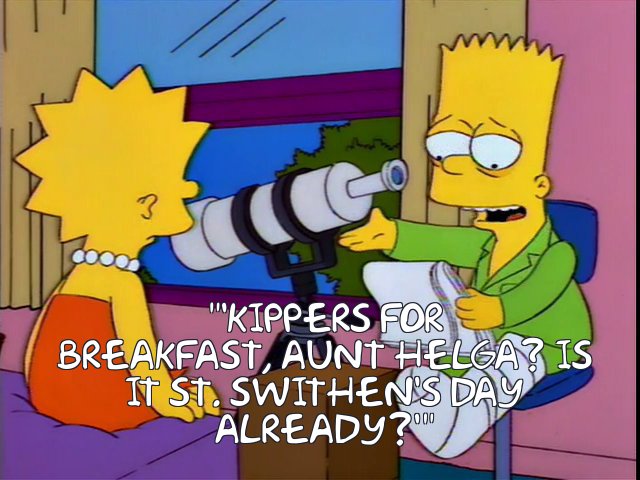
"'Tis!' replied Aunt Hellllga." — "Bart of Darkness", The Simpsons, S6E1
It goes on like this for fucking pages as Merry gives the writer an excruciating tour of her condominium and we learn all the different colors of paint and/or wallpaper in her home and what the floors look like and what color coat the writer likes to wear and how big the buttons on it are.
Stick a gun in my mouth. This book doesn't go anywhere, and it loves itself for staying in park with the engine running.
Allegedly, the older sister, Edgy Violet, is either making up ghost stories for attention because Edgy! or she's possessed, though there's no direct evidence of this. There's one engaging page in the first part of the book I won't ruin (it's gripping, literally), but blink and you'll miss it because the author only wrote this book to fixate on trying to describe a teenage girl who pisses herself while having seizures.
I think he might have a fetish.
There's potential in the book that's wasted here as the teen talks to her kid sister and tells her stories and they build a camaraderie as siblings often do. The teen tells scary stories, the child overreacts, and it's rather heartwarming — in principle — to see them bond, but my gripe is that there's scant moments of sisterly bonding in 100 pages and what's there doesn't go anywhere.
Nothing in this book goes anywhere.
Edgy Violet has a therapist who isn't helping, so Bible Dad decides on his own to start taking her to see a priest instead, to the consternation of Smokey Mom who just starts smoking more. Smokey Mom is a useless character except to disagree with Bible Dad, and Bible Dad is a doofus. Except for Edgy Violet, the Flump family is just terribly uninteresting. (Did you forget they had a last name? So did the author.)
It's decided Edgy Violet must be possessed and, rather than having her exorcised with consent of a bishop as the Catholic Church requires, nothing becomes of that diagnosis except it gets the attention of a film crew who decides to make a reality show of the family and fills their home with cameras.
This leads to a chapter about young Merry spending all her time playing with one of the TV show producers and kicking around a soccer ball in the back yard. Because that's important, maybe? I dunno, man. This book doesn't go anywhere.
While the camera crew is still working in the home the TV series airs, which isn't how TV shows work. Due to its mature subject matter, they send Merry — who I will reiterate here is the narrator of the book — to bed early so that the adults can watch the premiere of their own TV show that they're still making.
If you're confused and not seeing a connecting thread between these things: teenager with mental problems and/or demonic posession; women in a condo drinking tea with their pinkies out; playing soccer in the back yard; a blog about horror movies; then you're not alone. I'm not seeing a connection either. "A Head Full of Ghosts" reads like an anthology that just keeps cutting back to the same three stories that never go anywhere and never pay off: paint drying, grass growing, women sipping tea.
Perhaps if the first part of the story was half as long I wouldn't be so deflated about having to churn through as many useless pages of pointless banality as there are. Perhaps if there was some kind of narrative thread that tied disparate moments together this story of an adult reflecting on her sister's troubled childhood wouldn't feel so jarring. Perhaps the current-day chapters of Merry giving her interview to the writer wouldn't feel like someone trying to rub a copy of "Martha Stewart Living Magazine" against my raw corneas. Perhaps if the story started going anywhere I would want to see how it resolves.
This book is like putting The Three Stooges in The Haunting of Hill House and still trying to call it a horror film.
As a pseudo-memoir, this book fails miserably. As a horror novel, this book fails miserably. As a waste of paper, this book succeeds and if I had three wishes, one would be for the trees that died to make this book be brought back to life again. They did a far more important job turning carbon dioxide into oxygen than in conveying Paul Tremblay's words into thoughts in my brain. This book feels like it started out as a forgettable high-numbered cable channel TV movie screenplay edited into a novel at the last minute for contractual obligations by an overseas third-party firm who got paid by the word, but the structure of the original melodrama stayed put.
Things I would do differently if I had editorial sway over this book: make some of the characters interesting. Eliminate the role of Merry or for God's sake not make her the single perspective of the entire book. One chapter of Merry's naive perspective while her family melts down around her would have been refreshing and clever. Every chapter being Merry saying "I didn't understand what the grownups were saying, so I got bored and went to go play" is just fucking insulting.
Maybe the second half of the book changes perspective? That would've been nice. It's hard to imagine anything happening to Merry though, because she's alive and well to be able to tell her boring story in retrospect to a real writer. I would rather read what the writer's getting out of her story instead of her in situ thoughts as a child with no interest in conveying story elements to the reader. An author's job is to tell a story. Saying "I'm going to write this story from the perspective of a little girl who can't tell a story" is an abdication of one's duty.
There's an advantage to embedded journalism, when you can have a reporter there, live and in the flesh, recounting major world events as they happen. When that reporter's story is "Some people were arguing, and I didn't like that, so I decided to go watch SpongeBob," well, you get an idea of what trying to read "A Head Full of Ghosts" is like.


